
Build Your Own Pre-Workout: Doses That Actually Work Well
Most commercial pre-workouts fail a simple test: turn the tub around and check whether the headline ingredients could physically fit at their studied doses inside one scoop. They usually cannot. Building your own pre-workout takes ten minutes to learn and removes the guesswork permanently — you choose four ingredients with real evidence, dose them at the levels the studies used, and know exactly what you swallowed. This page is the hub; the exact mixing protocol is in the [DIY pre-workout recipe](/stacks/diy-pre-workout-recipe/), and every ingredient has its own deep-dive linked below.
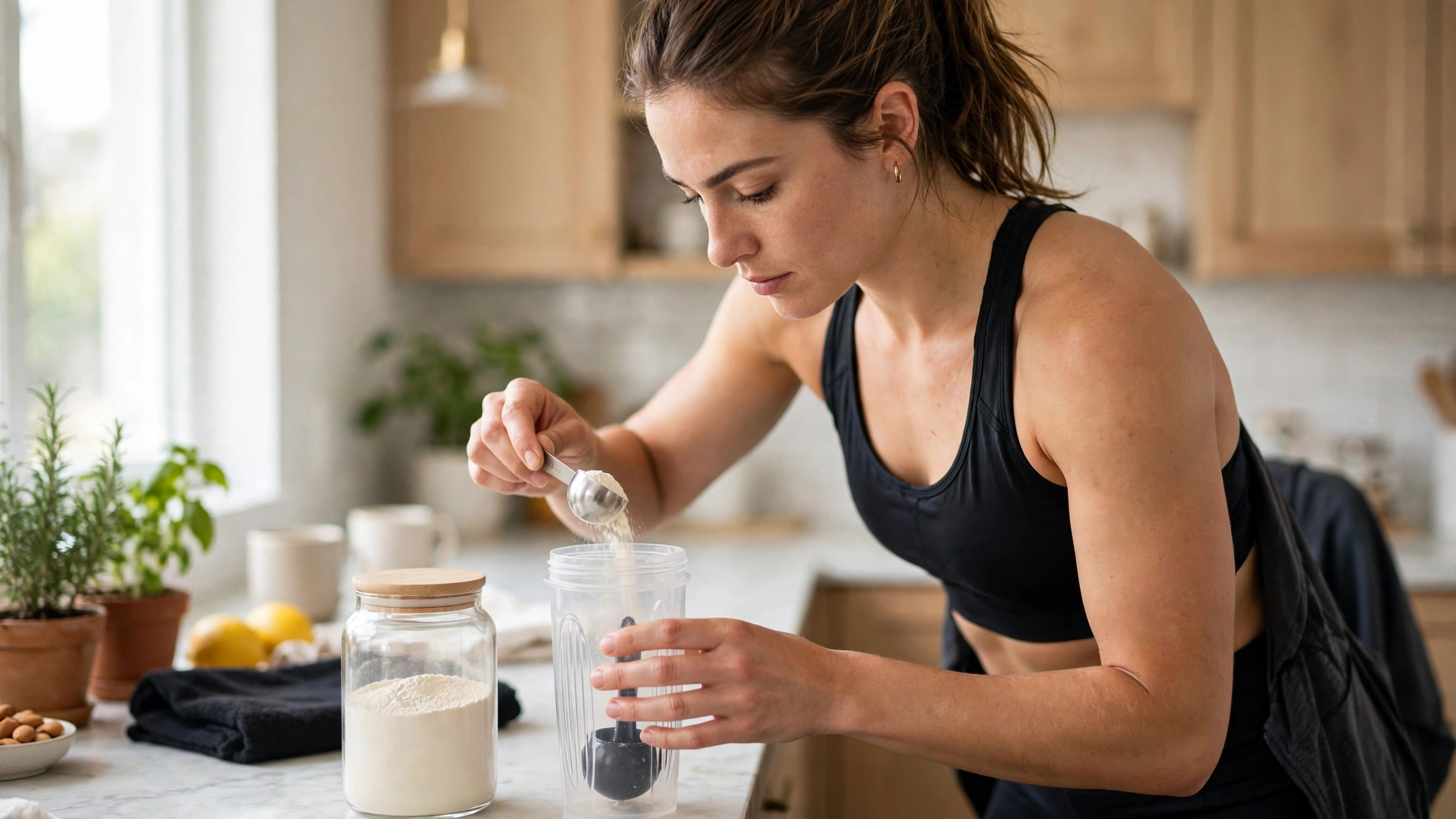
Most commercial pre-workouts fail a simple test: turn the tub around and check whether the headline ingredients could physically fit at their studied doses inside one scoop. They usually cannot. Building your own pre-workout takes ten minutes to learn and removes the guesswork permanently — you choose four ingredients with real evidence, dose them at the levels the studies used, and know exactly what you swallowed. This page is the hub; the exact mixing protocol is in the DIY pre-workout recipe, and every ingredient has its own deep-dive linked below.
What actually belongs in a pre-workout?
Four ingredients earn their place. Everything else commonly sold in pre-workouts is optional, underdosed, or both.
| Ingredient | Studied dose | What it does | Timing |
|---|---|---|---|
| L-citrulline | 6 g pure (or 8 g citrulline malate 2:1) | Raises arginine and nitric oxide; supports blood flow and reps | 30–60 min before |
| Beta-alanine | 3.2–6.4 g/day | Raises muscle carnosine, buffering acid in hard efforts | Daily, any time; split doses reduce tingles |
| Caffeine | 3–6 mg/kg body weight | Alertness, power, endurance; the strongest acute effect here | 45–60 min before |
| Creatine monohydrate | 3–5 g/day | Saturates muscle creatine stores over weeks | Daily, any time — not an acute ingredient |
Read the table by timing column, because it corrects the most common misconception in this category: only two of the four (citrulline and caffeine) do anything acute. Beta-alanine and creatine are saturation ingredients — they work because you took them for the last month, not because you took them 40 minutes ago. Brands blur this because “take before training” sells tubs. Your own mix does not need the blur; include beta-alanine and creatine in the shake if it helps you remember them, and know that is the reason.
Why is citrulline the base of the mix?
L-citrulline is an amino acid your kidneys convert to arginine, which feeds nitric oxide production — the pathway behind the “pump” and, more usefully, behind improved blood flow during exercise. It raises plasma arginine more effectively than arginine itself, which is why arginine has largely disappeared from serious formulas.
The dosing detail that sinks most products is the form. Pure L-citrulline is dosed around 6 g. Citrulline malate is citrulline bonded to malic acid, usually in a 2:1 ratio — so 8 g of citrulline malate delivers only about 5.3 g of actual citrulline. Products listing “6 g citrulline malate” in a blend are delivering roughly 4 g of citrulline and a marketing number. When you build your own, buy pure L-citrulline or pay for the full 8 g of the 2:1 malate. The full comparison, including what malate itself may add, is in the L-citrulline deep-dive, and the pair logic is covered on the citrulline and beta-alanine pair page.
How much beta-alanine — and why does it tingle?
Beta-alanine is the rate-limiting building block of carnosine, the buffer inside muscle that soaks up hydrogen ions during hard efforts lasting roughly 30 seconds to 10 minutes — heavy sets, intervals, combat-sport rounds. The International Society of Sports Nutrition position stand (Trexler et al., 2015) concludes that 4–6 g a day for at least 4 weeks significantly raises muscle carnosine and improves exercise performance in that window, with broader reviews supporting 3.2–6.4 g/day as the studied range.
The tingling — paresthesia — is beta-alanine’s signature side effect: harmless, temporary, and dose-per-serving dependent. The ISSN notes it is attenuated by divided doses of 1.6 g or less, or sustained-release forms. Build your mix at 3.2 g and split it (half in the pre-workout, half later) if the tingles distract you. The sensation gets its own honest explainer on the beta-alanine tingles page, and dosing strategy on the beta-alanine ingredient page.
How should you dose the caffeine?
Caffeine is the ingredient where “build your own” pays for itself fastest, because the right dose is personal and weight-based. The ISSN position stand on caffeine (Guest et al., 2021) puts the performance range at 3–6 mg per kg of body weight, taken about 60 minutes before exercise — for a 70 kg lifter, 210–420 mg. Many people get most of the benefit at the bottom of that range, and lower doses around 2–3 mg/kg still help, with fewer jitters and less sleep damage.
That sleep damage is not a footnote. Caffeine’s half-life averages roughly 4–6 hours (EFSA cites a mean of about 4 hours, range 2–8), so a 300 mg pre-workout at 6 p.m. leaves meaningful caffeine in your system at midnight. EFSA’s safety assessment concludes up to 400 mg a day from all sources does not raise safety concerns for healthy adults — but your coffee, tea and cola count toward the same total as your pre-workout. The full dosing framework, including tolerance, is in caffeine dosage. If you train late, skip the caffeine entirely and use the stim-free version of this stack — the other three ingredients do not care what time it is.
Practical caffeine sourcing for a DIY mix: tablets (usually 200 mg) are the easiest to dose accurately. Powdered pure caffeine is a genuine safety hazard — a teaspoon is several grams, tens of times a serving — and we do not recommend it. Coffee works too, with variable strength; energy drinks work, at a markup.
What should you leave out?
- Proprietary “pump” and “focus” blends — the category you are replacing.
- Arginine — inferior to citrulline at raising arginine levels.
- Excess niacin — the flush in cheap pre-workouts is theatre, not performance, and high doses have their own issues.
- Underdosed creatine (1 g “for the label”) — take 3–5 g or skip the claim.
- Anything you cannot pronounce a dose for. If an ingredient has no studied human dose you can name, it does not go in your tub.
Optional and defensible: taurine (1–2 g, some evidence alongside caffeine), betaine (2.5 g, mixed evidence), electrolytes for long or hot sessions (see the electrolytes cluster). Optional means optional — the four-ingredient core is the stack.
How do you know your mix is working?
Judge it the way the studies do: on output, over weeks, not on sensation in the first ten minutes. The stimulant ingredients announce themselves — caffeine’s alertness is obvious, and citrulline’s pump is visible — which tempts people to credit the whole mix for what one ingredient did, or to dismiss beta-alanine and creatine because they never announce themselves at all. Keep a simple log for the first month: session time, the dose you took, total reps on one or two benchmark movements, and a one-line sleep note. Beta-alanine and creatine earn their verdict at week four and beyond, in whether the last sets hold up better than they did in week one. Caffeine earns its verdict twice — in the session, and in that sleep column. If the sleep column degrades as the training column improves, your dose or your timing is wrong, however good the workouts feel. That single page of notes will teach you more about your own response than any review on the internet, including this site.
What about flavour, sweetness and your stomach?
The unglamorous truth of a DIY mix is that it tastes like its ingredients: tart from citrulline, nearly neutral otherwise. Very cold water, a squeeze of citrus, or a sugar-free drink mix solves it for most people within a week of habit. The bigger practical risk is gastrointestinal: six grams of citrulline in half a litre of water, drunk fast on an empty stomach, will find the people whose guts object. Drinking it over ten minutes, with a small amount of food beforehand if needed, settles almost everyone. If a particular brand of powder consistently upsets your stomach while another does not, believe your stomach and switch — excipients differ, and adherence follows comfort.
Who should not take this?
Building your own does not exempt you from the safety rules; it makes you responsible for them.
- Caffeine cautions: do not use caffeine-based pre-workout if you are pregnant (EFSA: keep total caffeine at or below 200 mg/day in pregnancy), under 18, or have uncontrolled blood pressure, a heart rhythm condition, or significant anxiety — without medical advice. Caffeine interacts with some medicines (it is cleared more slowly with certain antibiotics such as ciprofloxacin and with oral contraceptives, for example) — check yours with a pharmacist.
- Blood pressure medicines and citrulline: citrulline affects the nitric oxide pathway. If you take nitrates, PDE5 inhibitors, or antihypertensive medication, or you have low blood pressure, talk to your doctor before using it — additive blood-pressure-lowering is a real consideration, especially combined with training.
- Beta-alanine in pregnancy and breastfeeding: insufficient safety data — skip it.
- Kidney or liver disease: high-dose amino acid and creatine routines should be clinician-supervised.
- Competition athletes: you are responsible for anti-doping status. Caffeine is permitted, but buy tested products (the product table flags an NSF Certified for Sport option) and check your federation’s current list.
As always: talk to your doctor or pharmacist about your own medications before starting a pre-workout routine. The exact gram-by-gram build is waiting in the DIY pre-workout recipe.
The stack, product by product
| Product | Form | Dose | Third-party tested | Where to buy |
|---|---|---|---|---|
| BulkSupplements L-Citrulline Powder | Powder, pure L-citrulline | 6 g, 30–60 min before training | Check label | Brand site Amazon |
| Nutricost Beta-Alanine Powder | Powder, unflavoured | 3.2 g daily, split if tingling bothers you | Check label | iHerb Amazon |
| Caffeine tablets, 200 mg (any pharmacy own-brand) | Tablets — dose by body weight, not by scoops | 3 mg/kg (about 200 mg at 70 kg), 45–60 min before | Check label | iHerb Amazon |
| Thorne Creatine | Powder, creatine monohydrate | 5 g daily, any time | NSF Certified for Sport | iHerb Brand site Amazon |
Prices change constantly, so we don't print them — check the current price at the retailer. We only list products that publish third-party testing (NSF, Informed Sport, or USP) where a certified option exists.
Frequently asked questions
Is it cheaper to build your own pre-workout?
Usually yes, per effective dose. Branded pre-workouts charge for flavour systems, marketing and ingredients dosed below study levels. Buying citrulline, beta-alanine and caffeine separately typically costs less per serving than a premium tub — and every gram is an ingredient with evidence, not filler.
Do I need to take beta-alanine right before training?
No. Beta-alanine works by raising muscle carnosine over weeks of daily use (3.2–6.4 g/day for at least 4 weeks per the ISSN position stand). Timing within the day does not matter for its effect. Many people include it in the pre-workout for convenience — and split the dose, because one large dose causes strong tingling.
What can I skip if I train in the evening?
The caffeine. Citrulline and beta-alanine carry no stimulant effect, so an evening version keeps the pump and buffering components and drops the ingredient that costs you sleep. Our stim-free pre-workout stack page builds exactly that version.
Are proprietary blends really underdosed?
Often, by arithmetic. If a blend totals 5 g and lists six ingredients, they cannot all be at studied doses — citrulline alone needs about 6 g. A blend that hides individual amounts asks you to trust that the cheapest ingredients are not doing most of the weighing. Build your own and the maths is yours.
Should creatine go in the pre-workout shake?
It can, for convenience, but timing does not matter for creatine — daily saturation does. 3–5 g of creatine monohydrate at any consistent time works. Putting it in the pre-workout is simply an easy way to never miss a day.